Curated by D*Face
Our Signature Artist’s personal favourites from London high street to t-shirt brand.
This article was originally published in June 2024 in Curated edition 2.
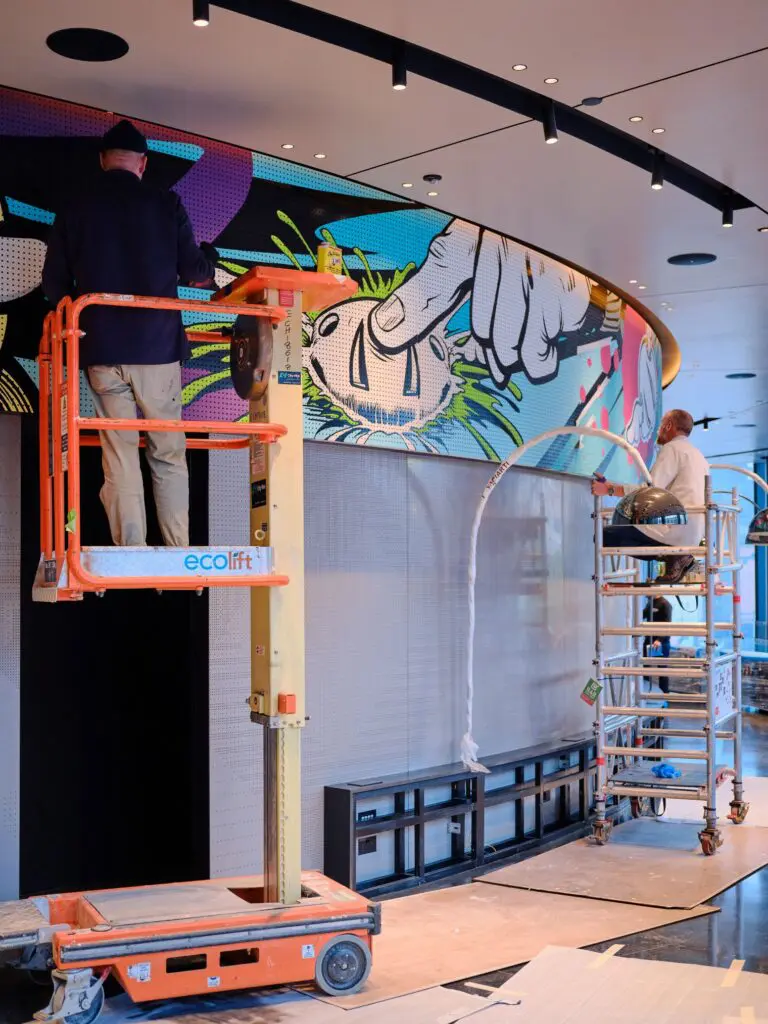
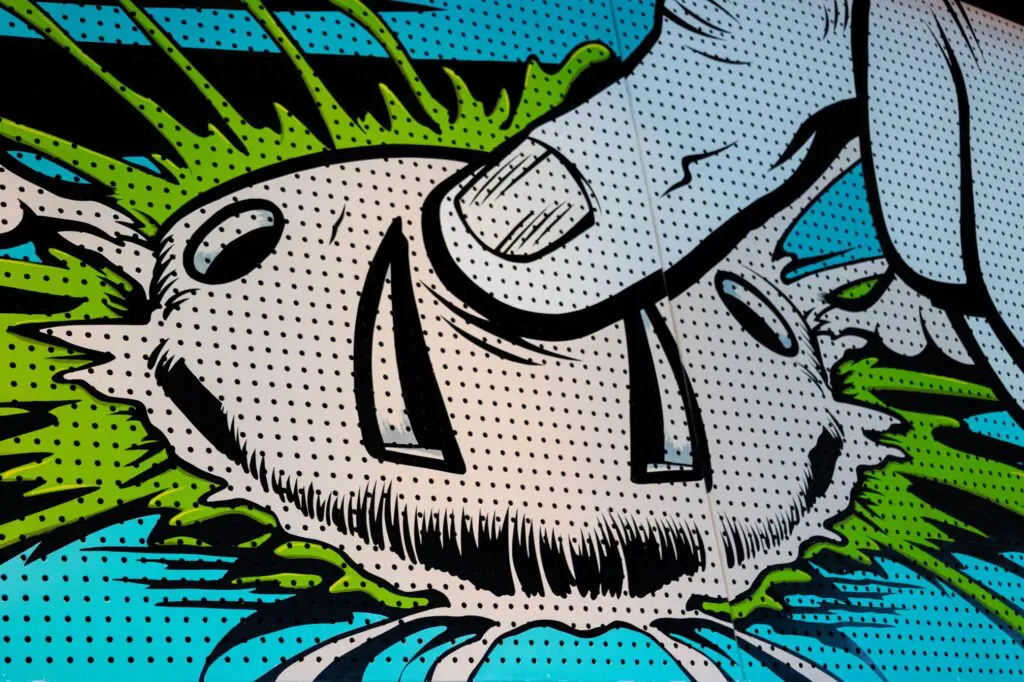
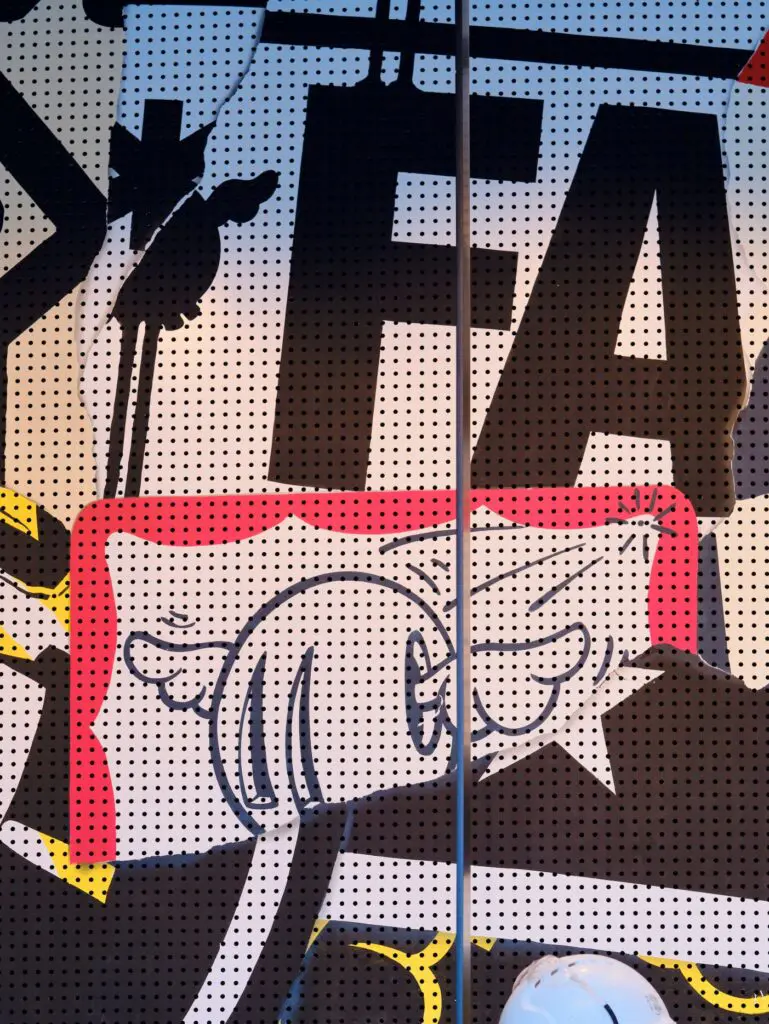
When photographer Rory Cole and I approach the gate to Dean Stockton‘s Peckham studio, the sun is shining and the air is warm—a little unusual for February in London, but this isn’t a usual day. Two massive metal panels are arriving from “the shop.” They’re only a section of a much larger installation poised for art’otel London Hoxton. Up close, it’s difficult to discern what’s on them. Take a few steps back and the image on the panels slowly reveals itself: a panoramic collage of D*Face stickers. I ask Stockton what this is all about. “It started as that—” he says and tosses me a strip of paper decked out in his iconography “—that’s the original. It’s been scanned, printed out in large-format and we used that as our base. Then we block out all the colour, put black over the top, and go around to add in the shadows.” The shadows, he notes, are key.
And now the enormous metal fabrication of HI MY NAME IS in front of me is all starting to make sense.

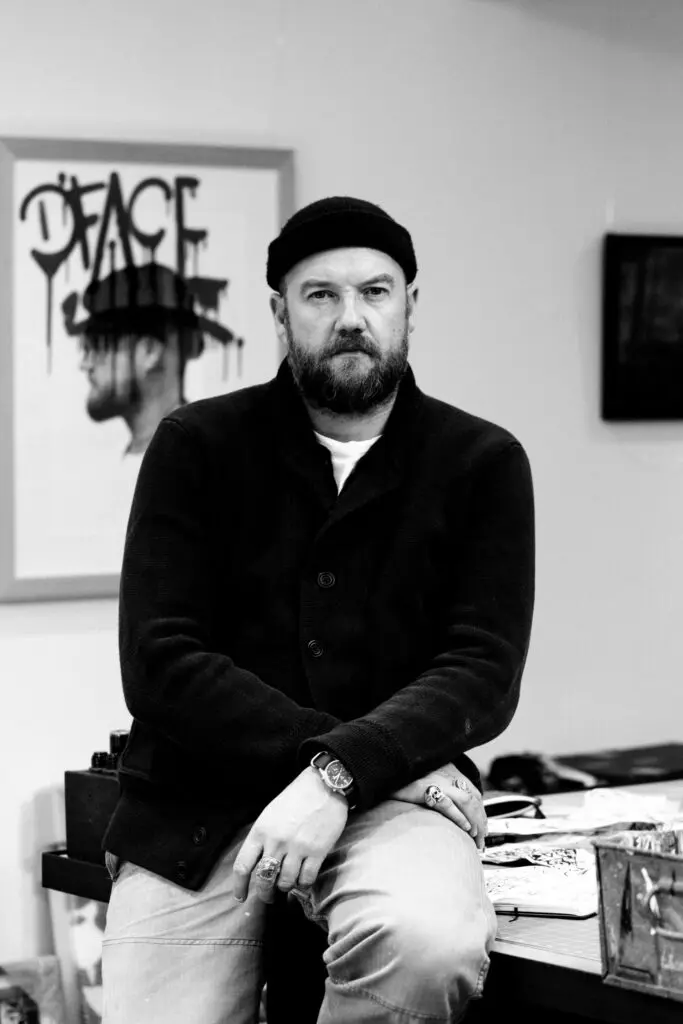
D*Face is globally recognised for his supersized, hand-painted murals in cities like LA, Tokyo, Berlin and (of course) London. Stickers, though, are what put him on the map. He reckons he’s stamped “hundreds of thousands” of them. But this iteration was born from a broken wrist as much as it was connecting with his roots as an artist. “I couldn’t paint” he explains, so he needed something post-skateboarding accident to keep his creative bone occupied (while the physical bone was healing). In this case, inspiration hit in the form of stickers on brown paper envelopes he was mailing. He simply thought it “looked cool” and it grew from there.
“I started cutting and tearing things out, made a book of collages and, when I was finally able to paint, we painted them. So, this [panel] was informed by that. But also, stuff in the street. When you put stickers up, people put more stickers up next to them. Over them. They age. That for me is a way of appreciating the elements out of your control—the ephemeral nature of working with the public domain where things are weathered and destroyed. Early days it’s heartbreaking, but as you get older you have to embrace it.”
The purpose of my visit to him today is to get his list of London favourites (for anyone who might be interested, but really for myself as an admirer of his work and a regular visitor to his gallery, StolenSpace). So, it feels fitting to start our interview with his favourite place to pop a sticker.
Sticker Location
“One of the earliest places I put stickers were – I still to this day don’t know what they’re called – but there are these grey boxes they put on lamp posts. They’re a perfect square with a rounded corner. Probably five-inches square, at perfect six-foot height. And that was one of the first things I’d seen as a spot for stickers. I thought ‘that’s a cool little blank canvas’ so I measured them and made hand–drawn stickers to fit. They went unnoticed and untouched for a long, long time. I was linking all my routes across London with these little boxes. Those I still have a fondness for. But any fresh grey coat of paint is delightful to put a sticker on. I’ve got a device that I’ve created to put stickers up high so I can get those spots you couldn’t possibly reach or physically climb to, and they run forever. I’m into trying to keep stuff up and out and visible as possible in as prominent a location as possible.”
Street or Neighbourhood
“Peckham High Street. I don’t want to give you Peckham as all my answers, but here’s the thing about London as I see it: locals spend the most time where they call “home.” It feels like [Peckham] is a community. You get to know the guy on the block that you see every day and the mad woman who talks to the cats, and I think that sense of community and how you fit within that is important. I love the diversity of this area. There’s a certain element of edge to it which makes it real. My studio has always been East and South is my home.
Aside from that, I still like walking around Bond Street central London and looking at the architecture and the establishments that have been there forever.”
Blue Plaque
“Boris Karloff! I found Boris’s plaque just up the road. I was walking along (and I’ve been down this street many times) and weirdly someone was talking about the original Mummy the day before, then I look up and see ‘Boris Karloff lived here.’”
T-Shirt Brand
“I’ve got so many t-shirts. They breed. Every time we go anywhere, we get t-shirts. I recently got back into skate brands and have been picking up loads of skate t-shirts. I don’t have one favourite. I like any of the old school skate brands. Santa Cruz. Jim Phillips is my favourite artist and graphic designer and I just think they have awesome graphics. I like old stuff that’s got a story to it.”
Gallery
“White Cube Bermondsey. The curation – but that space alone is absolutely incredible. Then my own gallery, of course, StolenSpace (17 Osborn St, London).
I never wanted to be a gallery owner or curator. I’d been looking around at what I was doing and what peers and artists that were part of a similar scene were doing—and I kept thinking ‘why isn’t someone showing this in a gallery format?’ We were getting all these opportunities to hang stuff in a bar or a shop (and there’s nothing wrong with that) but I felt like it deserved more. Then a year rolls by and someone says to me ‘you’ve talked about it so much why don’t you do it?’
I thought, f*ck it, why not?
That was in 2004 and it was called The Outside Institute at that time, and it pretty much ran me into the ground. I learned everything about what not to do in that year. Then I started again, but smaller and with a studio attached to the gallery that could fund it. StolenSpace has been operating since 2005.
Running an independent gallery is incredibly tough. It’s so easy for people to go ‘oh you just get a space, paint it white, put some lights on it, hang the work and sell it right?’ Go on then, try it. It’s so demanding. There’s a constant drive to make it make sense and fund it – and also, we genuinely want to sell work for the artists.
That’s the one thing about StolenSpace I’m most proud of: we’ve launched loads of artist’s careers. You get to see those artists from having their first shows to finding major success and that, for me, is the fulfilment. Running a gallery is a pure labour of love and it’s great that it supports them.
So yeah, I’d say check out White Cube, the Tate Modern—I just went to Ladbroke Hall and that space is great as well. We’re spoiled for choice in London, aren’t we?”
Art Supply Store
“Atlantis Art Materials is always a classic. I love going to art shops. There’s something about going there that is awesome to this day. I go with my kids, and we always come out with stuff that nobody needs.”
Local Music Venue & Artist
“Brixton O2. I like it because it’s close for me to get to and it’s a great venue at a good size—big enough to hold a decent-sized band but not too big for you to feel like you’re just a tiny spectator in a sea of people.
Artist-wise, we listen to so much music in [the studio]. Don’t really pay attention to where they’re from. UK artist I’d say Arctic Monkeys. But I love all sorts of stuff. Bristol scene—Portishead and Tricky back in the day—to grime. Stormzy. Skepta.
Beyond local, when I’m traveling or painting a mural, I like to look up who’s playing and try to coincide the visit with that. I saw Dinosaur Jr. playing in Richmond, Virginia, which was random but great.
Coffee Brand
“I love morning coffee. I really respect roasters pushing the limit but, as I’ve gotten older, I just want it to taste like coffee. Dark Arts Coffee has been my go-to for a while. Square Mile Red Brick Espresso is what I rock at the moment.”
Skate Park
“Crystal Palace skate park. It’s awesome. It’s got a cool little crew of people that are regularly there at 7:30am. South Bank too—long live the South Bank.”
We have time for one more question and, as a North American, I feel strongly obliged to ask if he prefers a Full English or American pancakes for breakfast.
“English all the way. I hate pancakes. Wherever I go, it’s not pancakes. But I rarely eat a Full English these days because I try to be as healthy as possible. It’s a rare treat. Porridge in the morning with a coffee and Huel for lunch.”
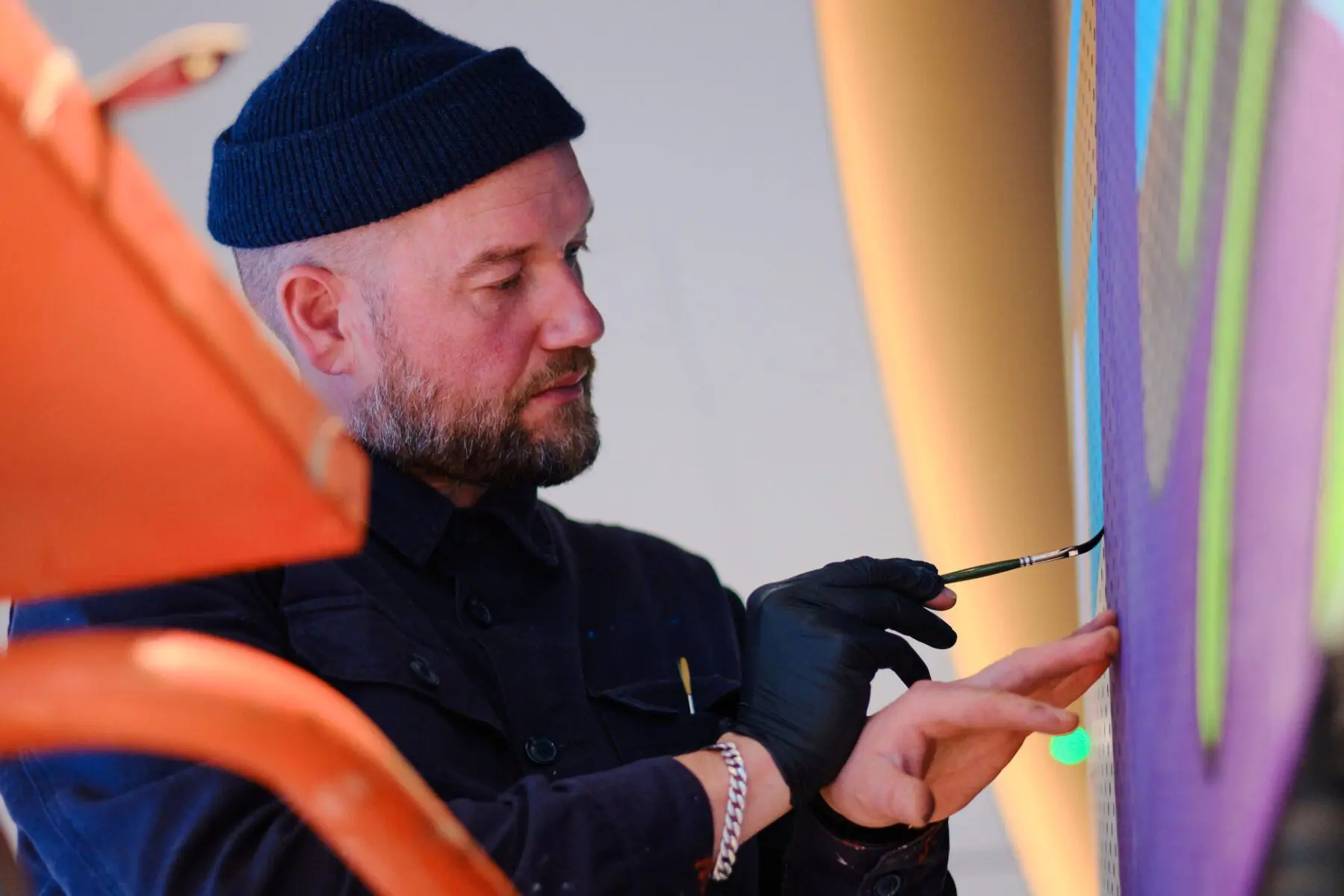
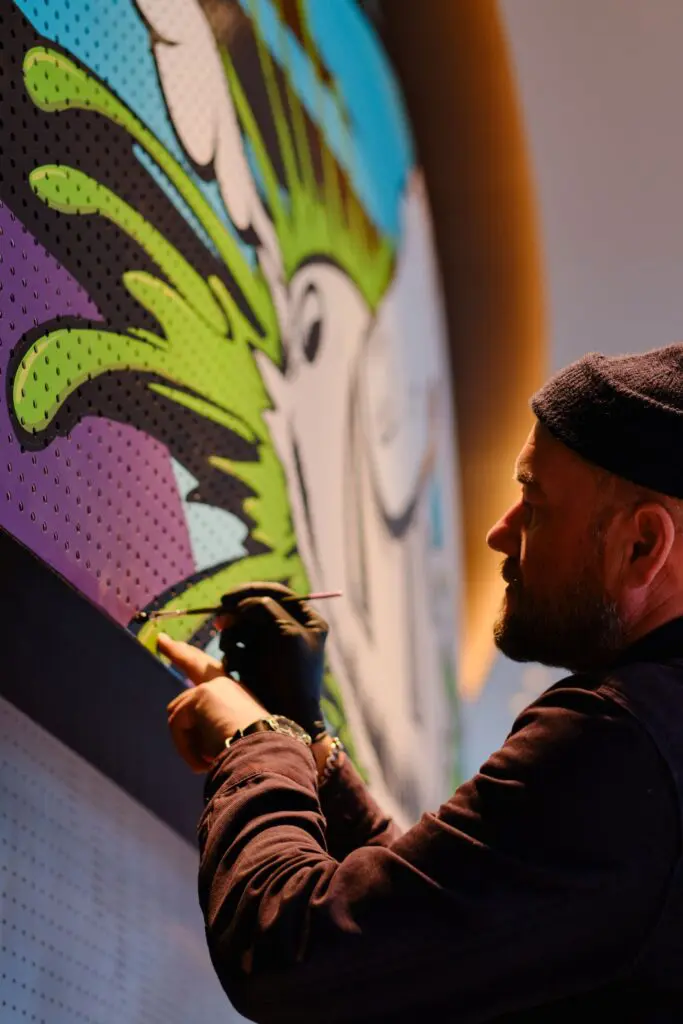
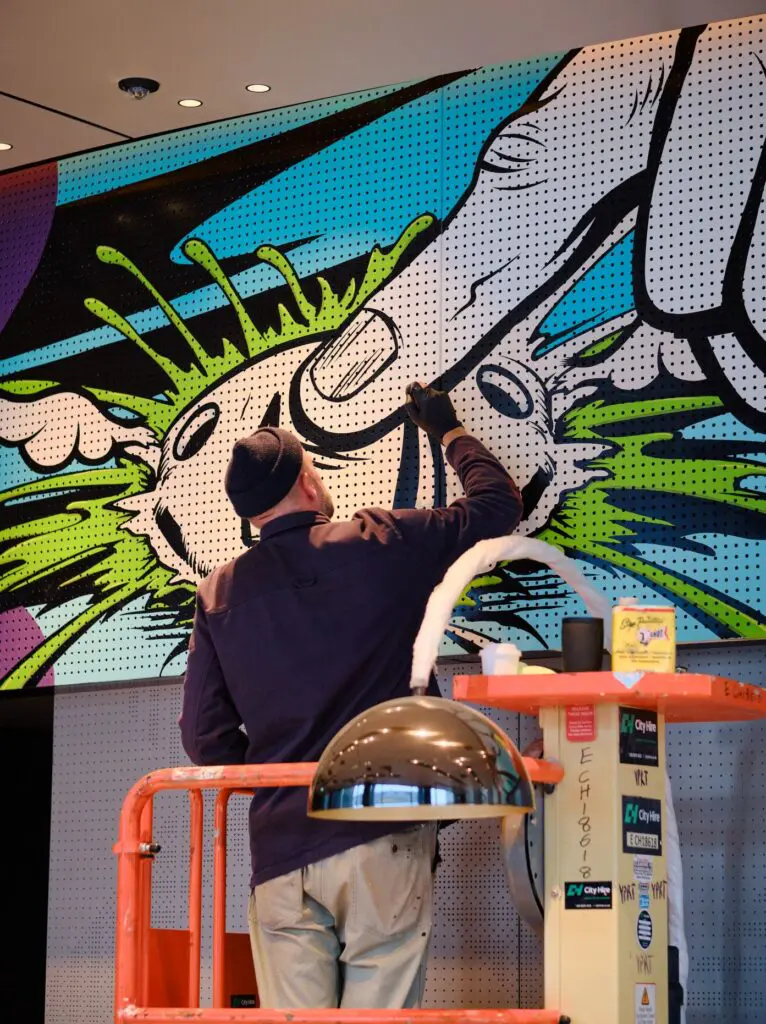
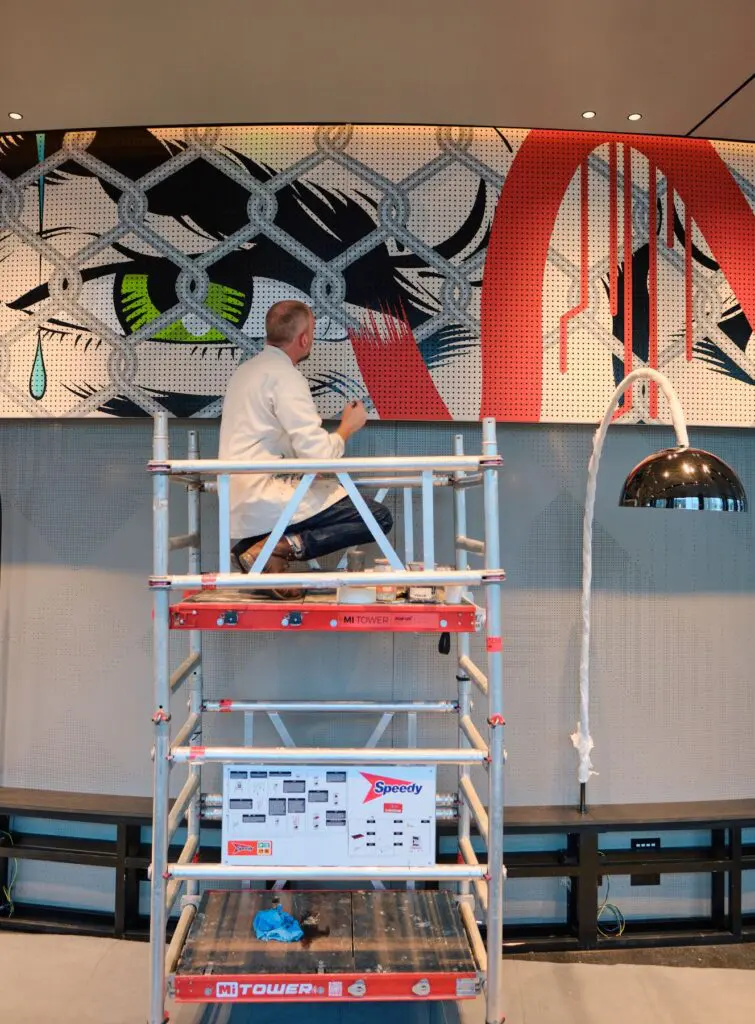
By this point Stockton has grabbed a small paintbrush and is using to touch up certain areas of the panels so they’re a perfect, uniform shade. Even after a couple hours of being around them it’s hard to fathom the work that goes into something of that scale—but watching the little brush tip on the floor-to-ceiling slab certainly puts it into perspective. And in the context of the hotel, this meticulousness also makes a lot of sense. His chosen theme? Mark making.
“I didn’t want [the theme] to be singular because I don’t do that – I always look to my body of work like chapters of a book—I don’t want to close that chapter and never go back to it, but I want to progress and try new things to keep myself interested. For this, I wanted to be able to embrace all the things I’ve done and (where it was suitable) apply it. I felt like mark making was symbolic and allowed me a lot of scope to stretch into. I could embrace the variety of elements I work within (from stickers to posters to tags to graffiti) and dig through various aspects of both the Hoxton area and my archive and feed into that.”
As Rory and I start to pack up our things (several niche film cameras, a tripod and a few other photography bits) I ask Stockton if he has anything else to say to my readers.
“Support your local skate shop. Support your local art shop.”

