
Curated By: Art Beyond the Frame
Before Alisa Lisovskaia worked in museums, galleries and hospitality, her introduction to art came through a collection of postcards.
Her grandmother would turn each card over to reveal a reproduction of a painting or sculpture, then ask Alisa to name the artist and era. What began as a childhood memory game became the foundation of a career spanning museums around the world, London galleries and, today, her role as Art and Culture Programme Manager at art’otel London Hoxton.
“For me, art was always global,” she says. “It’s another language we speak.”
It’s an idea that shapes the programme she now curates: art as a way to communicate across countries, disciplines and levels of experience, whether someone regularly visits galleries or is encountering an artist at work for the first time.
An early education in art
Alisa’s childhood was filled with different artistic forms. Alongside her grandmother’s postcards, there was her mother’s love of ballet and opera, art forms that she admits weren’t always easy to understand on a first visit.
That complexity never discouraged her. Instead, it showed her that finding a way into art could take time, curiosity and, sometimes, the guidance of someone willing to introduce you to it.


Her professional route followed a similarly expansive path. Over 15 years, Alisa’s worked across museums and galleries, including the Moscow Kremlin Museum, Tretyakov Gallery and Peggy Guggenheim Museum, as well as several galleries in London.
Each environment presented a different perspective. Museums gave her experience in preserving and interpreting established artistic legacies. Galleries introduced her to artists and the commercial art world. One London gallery was dedicated entirely to street art, a fitting connection to the work she would later undertake in Hoxton.
Hospitality allowed her to bring these experiences together.
“At the hotel, we mix different practices,” she explains. “We work with emerging talents, brands, galleries, curators and artists, and we bring them into the hotel.”
Curating beyond the gallery
A hotel presents a different curatorial proposition. Visitors aren’t necessarily arriving with the intention of seeing an exhibition, and their knowledge of art may range from extensive to almost none.
For Alisa, that breadth is part of the appeal.
art’otel London Hoxton has a dedicated gallery, auditorium and artist’s studio, creating several ways for guests and visitors to encounter art. A digital exhibition might fill the gallery’s walls, a screening or discussion may take place in the auditorium, while an artist develops new work in the studio nearby.
The artist residency provides perhaps the most direct introduction. Artists work at the hotel for several weeks, opening their practice to conversations, studio visits and workshops. Guests can see the materials taking shape on their tables, learn about the ideas behind a piece and, in some cases, take part themselves.
“We have different levels of how we introduce art to our guests,” Alisa says. “The residency allows people to meet an artist and see what kind of practice they have and what materials they’re using.”
The studio is both a working space and a point of exchange. An artist still needs the freedom to concentrate, but openness is an important part of the residency. Alisa looks for artists who are willing to speak about their work, share unfinished ideas and invite people into processes that can otherwise feel hidden.
“It creates a bridge between the residency programme, the artist in residence and the guests,” she explains.
Living with the work of D*Face
That bridge begins before anyone reaches the studio.
The visual identity of art’otel London Hoxton was created in collaboration with its Signature Artist, D*Face, the London-born artist also known as Dean Stockton. His comic-inspired imagery and satirical approach have made him one of the most recognisable figures in contemporary street art. His connection to East London stretches back to the early days of his career, when he placed stickers around Shoreditch, while his StolenSpace Gallery became London’s first contemporary gallery dedicated to urban art.

At the hotel, his work isn’t confined to a single exhibition space. It appears across digital screens, murals, sculptures, books, skateboards, guest rooms and public areas. Outside, the 16-foot cast-bronze sculpture of D’s Little Helper, the artist’s anthropomorphic paintbrush character, marks the entrance.
“D*Face is everywhere, in every element of the hotel,” Alisa says. “Guests keep discovering new pieces while they’re walking around.”
D’s Little Helper is particularly adept at appearing where it is least expected. The character surfaces in murals, on shelves and throughout the rooms, turning the experience of exploring the hotel into a visual search.
For Alisa, this sense of discovery makes the art approachable. A guest doesn’t need to understand the history of street art before noticing a winged figure, a supersized brush or a suspended sculpture. The work catches the eye first. Questions can follow.
“The little brushes are everywhere,” she says. “They are guiding you through the hotel.”
A studio in constant motion
While D*Face gives the hotel its central visual identity, the residency programme introduces a continually changing group of artists, disciplines and materials.
Alisa is interested in artists who expand what guests might expect to find in a hotel studio. Past residents have worked with painting, textiles, jewellery, wood and metal. The programme has welcomed artists from the UK and abroad, providing recent graduates and emerging talents with the time and space to develop their practice while meeting an international audience.
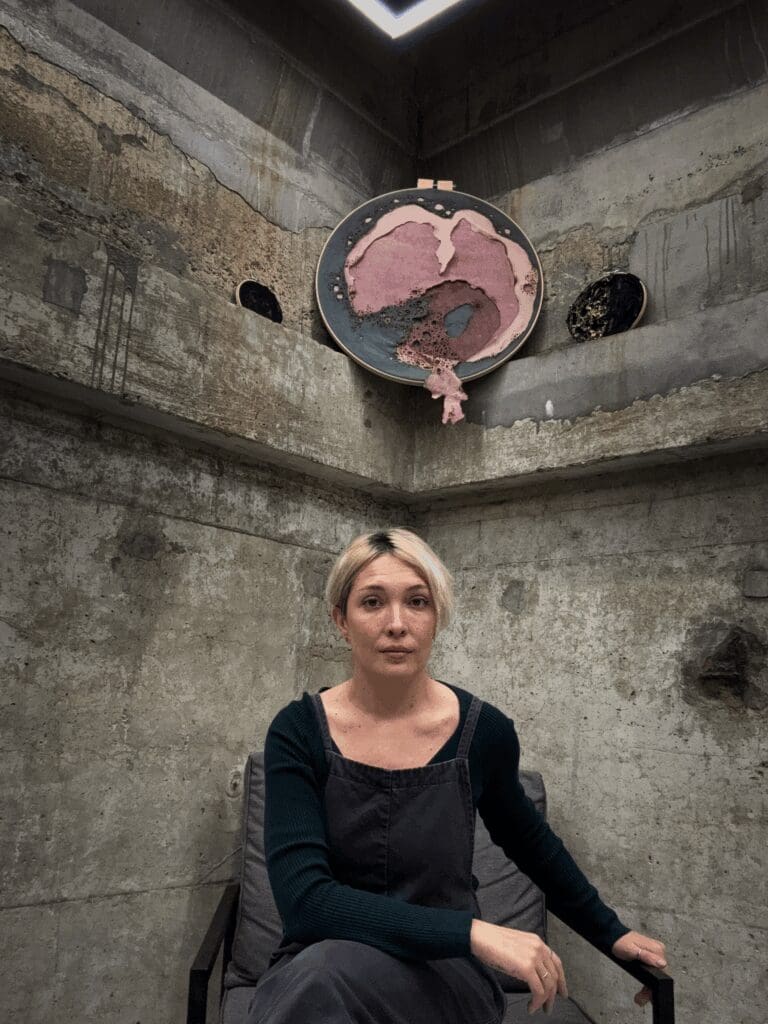
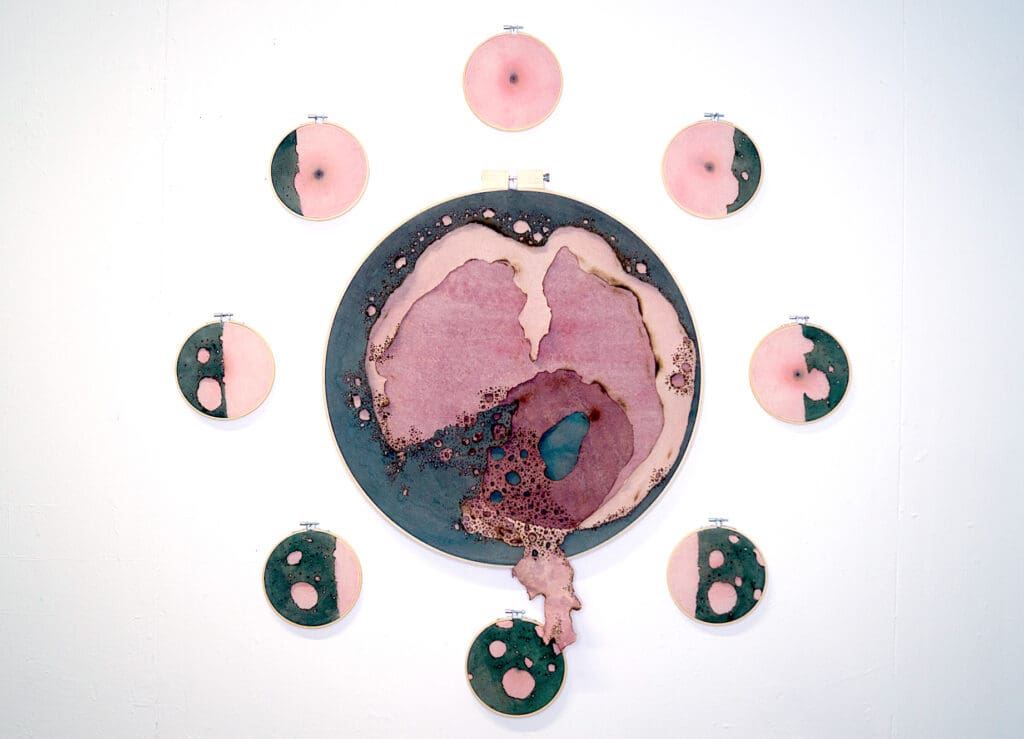
One recent resident who particularly captured Alisa’s attention was Ekaterina Adelskaya, whose work reconsiders the tools and materials associated with embroidery.
Using wooden embroidery hoops, fabric, paper and oxidised metal, Ekaterina explores what she calls the “anti-stitch”. Rather than sewing conventionally, she burns, tears and layers materials to produce alternative forms of mark-making.
“I like the challenge in her practice,” Alisa says. “She uses the same tools but finds other ways to reproduce the appearance of embroidery.”
The work looks towards the domestic traditions practised by generations of women, including figures from the artist’s own family, while refusing to simply repeat them. Familiar materials are stretched into unfamiliar forms.
This balance between inheritance and experimentation is what appealed to Alisa as a curator. The work contains an accessible point of recognition, then opens into wider questions about family, architecture, nature and how practices traditionally associated with women can be reinterpreted.
It also lends itself naturally to conversation. Visitors could see the metal leaves, wooden frames and altered textiles inside the studio rather than encountering only the finished work on a gallery wall.
Making art something you can enter
Workshops extend this invitation further. Often hosted by the artist in residence, they bring guests, local visitors and families into direct contact with a particular process. Depending on the artist, participants might work with tracing paper, fabric, wood, clay or other materials, while hearing how the workshop developed from the artist’s wider practice.

For the artist, teaching can be a challenge of its own. It requires them to explain decisions that may ordinarily remain instinctive and to consider how someone else might approach their techniques for the first time.
For participants, the value lies in removing some of the distance that can surround contemporary art. Instead of being asked to arrive with specialist knowledge, they begin with a material, an idea and the artist in front of them.
“You can talk to the artist about how they came to their practice and how they developed the workshop,” Alisa says. “It’s a chance to enter the art world.”
That principle runs throughout the wider art’beat programme at art’otel. Exhibitions, artist talks, screenings, gallery tours and panel discussions each provide a different point of entry. There’s no single correct route and no expectation that everyone will connect with the same work.
If a guest tells Alisa that they don’t understand art, she would begin with a tour. She might introduce them to D*Face’s work around the hotel, point towards the street art outside or open the door to the artist’s studio. From there, a conversation, workshop or exhibition may provide the connection they were looking for.
A hotel in conversation with its surroundings
The programme also reaches beyond the building. Hoxton and neighbouring Shoreditch have long associations with London’s street-art culture, making the area a natural setting for D*Face, whose career began in this part of the city. His art now connects the hotel’s interiors with the murals, studios and galleries beyond its doors.
For Alisa, working with local initiatives, collectives and cultural organisations allows the programme to remain in conversation with that setting.
Each collaboration introduces a new group of people to the gallery and auditorium. The result is an arts programme shaped not only for hotel guests, but for artists, Londoners and communities across the city.

“Our projects bring their own audiences and their own communities,” she says. “They become part of our wider circle.”
The hotel’s digital gallery offers further scope for this exchange. Eight projectors allow the space to host moving-image work and large-scale digital exhibitions, while the adjoining auditorium creates room for conversations around subjects including art, technology and artificial intelligence.
Traditional materials might occupy the artist’s studio above while video art shifts across the gallery walls below. To Alisa, these different forms do not compete. They’re part of the same evolving programme.
Art as an invitation
Alisa describes hospitality as the “business of emotion”, a phrase that feels particularly apt in a hotel where art accompanies the flow of the day.

A guest might first encounter it on the digital screens beside the escalators, then notice a sculpture in the lounge, find a catalogue in their room or pass the artist’s studio on the way downstairs. Later, an exhibition, workshop or conversation may bring them closer to the work.
Unlike a gallery visit, there’s no set beginning or end. Art slips into breakfast, a walk through the lobby or the quiet of returning to a room.
“You can meet art at every step,” Alisa says.
Her role is not to prescribe how somebody should respond. It’s to create enough ways into the work that everyone has the opportunity to find their own.
The postcards her grandmother once held up gave Alisa her first route into art. Years later, she’s creating new entry points for others, one exhibition, studio conversation and unexpected encounter at a time.

